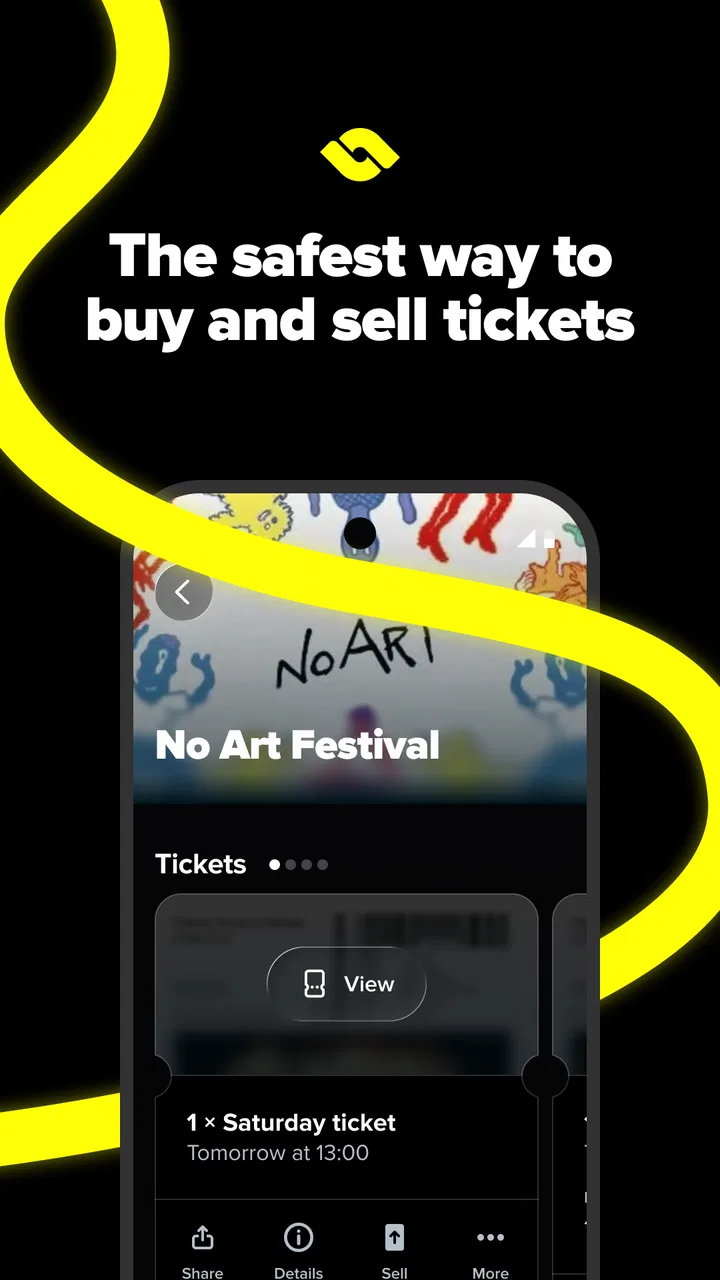
TicketSwap - Buy, Sell Tickets
- 4.2
- Rating
- 1.00M
- Installs
- Free
- Price

 Analysis by App-foxy
Buying a ticket from another person can be exciting, but it can also become stressful when the event is close and the details are scattered across messages, payment screens, and digital passes. I tried TicketSwap with that situation in mind, paying particular attention to how clearly it presents listings, how easy it is to move through the buying and selling process, and how practical it feels for people using it in different everyday circumstances. My overall impression is that it is a focused events app rather than a general marketplace, and that focus makes the experience easier to understand than arranging a resale through social media.
Developed by TicketSwap, this free events app is built around buying and selling tickets for concerts, festivals, sports occasions, clubs, and other events. It has been available since January 8, 2016, and its Android listing shows a 4.3 average from around 55 thousand ratings, with over one million installs. Those figures suggest that it has become a familiar destination for people who need a ticket after an event sells out or want to pass on one they can no longer use.
How TicketSwap feels to use in real situations
I focus here on the part that most changes the experience: keeping a ticket resale tied to a specific event instead of handling it through scattered messages. In real use, that gives me a clearer place to check what is being offered and decide whether it suits my plans. The difference becomes easiest to judge in the everyday situations where timing and details matter.
You May Also Like

 Blood Strike: 2.5 Anniversary
Blood Strike’s Loadouts Turn Every Drop Into a Tactical Gamble
A close look at Blood Strike’s custom loadouts: how fast access to signature weapons reshapes its battle royale rhythm, rewards preparation, and narrows the gap between fights.

 Pandora - Music & Podcasts
Pandora’s Music Is Easy to Start, but Harder to Recover
Pandora’s strength is its low-effort path from a seed to a station. Its weak spot is how much confidence it asks you to place in connection, setup, and quiet recovery.

 8 Ball Pool
 Is Built on Rivalries, Rematches, and Routine
A close look at the rivalries, rematches, shared routines, and unanswered safety questions that turn a quick pool match into a persistent mobile community.

 Samsung Music
’s Quiet Strength Is Playing What You Already Own
Its reach comes less from spectacle than from dependable access to a personal library. That simplicity is both the app’s strongest retention engine and its ceiling.

 AccuWeather: Weather Radar
AccuWeather Review: A Quick, Clear Forecast for Everyday Decisions
For everyday plans, the best forecast is the one you can understand quickly. AccuWeather makes rain timing, radar, and local conditions easy to act on, with a few trade-offs.

 Hill Climb Racing
Why Hill Climb Racing Still Turns Crashes Into One More Run
A tiny car, a bumpy hill and one more upgrade: Hill Climb Racing keeps resurfacing because its simple chaos makes every near-miss feel personal.
More From Our News Desk



Readability and navigation when time matters
The most important strength is that the app gives the ticket itself priority. Instead of making me search through a long conversation with a stranger, I can start from an event and inspect the available offers in one place. That is a much more sensible structure for last-minute decisions: I am looking for a particular event, not browsing an unlimited collection of unrelated second-hand goods.
The basic journey is easy to understand. I would search for an event, open the relevant listing, check the ticket information, and then decide whether to continue. For selling, the process follows the opposite direction: I select the event, add the ticket details, and put it in front of people already looking for that occasion. This event-first arrangement reduces the amount of mental sorting required, especially when several people are sending me possible tickets at once.
That said, readability is not only about large text or clean screens. Ticket purchases contain details that deserve careful attention: the event name, date, venue, ticket type, and any seating information. I recommend slowing down at the confirmation stage rather than relying on a quick glance. A familiar venue name can still hide a different date or ticket category, and no resale app can make a rushed buyer immune to human error.
For someone who is easily overwhelmed by crowded interfaces, the focused purpose is helpful. The app is not trying to be a social feed, a travel planner, and an entertainment catalog at the same time. I can approach it with one question—“Can I safely find or transfer a ticket for this event?”—and the screens generally support that question.
Navigation habits that make the process clearer
One useful habit is to search by the exact event rather than beginning with broad browsing. This limits distractions and makes it easier to compare listings that actually relate to the occasion I want. I also find it sensible to read the complete listing before thinking about speed. A low price or a convenient location is not enough if the ticket type does not match what I need.
Another practical point is to keep the app open while checking the ticket information, instead of switching repeatedly between messages and other apps. Constantly moving between screens can make it harder to notice whether a detail belongs to the ticket I am considering or to another offer. For users who depend on screen magnification, larger system text, or a high-contrast display, the best experience will depend partly on how those settings interact with the phone and the app. I would test the important screens before an urgent purchase, not at the entrance to an event.
The app is rated for Everyone, which fits its broad purpose: it is designed for ordinary ticket transactions rather than mature entertainment. That rating does not remove the need for adult attention when money, identity, travel, or an important event is involved. A younger user may understand the interface but still need help with payment decisions and the consequences of buying the wrong ticket.
Motor and sensory considerations during a purchase
Ticket buying is a task where small interaction problems can have large consequences. A missed tap, an accidental back gesture, or a rushed confirmation can interrupt the process at the worst moment. I prefer using the app while seated and connected to a stable network, with enough time to read each screen. That is not a criticism unique to this service; it is a sensible precaution whenever a purchase depends on several sequential steps.
For users with limited dexterity, the most useful approach is to avoid trying to complete a purchase while walking, carrying bags, or standing in a crowded queue. A larger device or a phone held in a stable position can make selection and review easier. Voice control, switch access, screen readers, and other operating-system tools may help some users, but the exact experience can vary by phone and software configuration. I would not assume that every ticket detail will be equally easy to hear or navigate without testing it first.
Sensory load also changes with context. A bright festival environment, loud music, poor reception, and a nearly empty battery create a very different experience from using the app at home. If I were attending an event with a user who has visual, hearing, cognitive, or sensory needs, I would prepare the ticket before arriving and keep the essential information available in the way that person finds easiest to use. The app can organize the transaction, but it cannot solve every problem created by the venue or the surroundings.
For sellers, motor effort appears in a different form. Adding a ticket requires care with information and possibly handling the original ticket file or details. I would prepare those materials before opening the selling flow, rather than trying to photograph or locate them while distracted. The less juggling involved, the lower the chance of attaching the wrong document or entering an unclear description.
Situational access: the app away from home
The clearest everyday use case is a sold-out show that a friend invites me to at short notice. Instead of asking around in group chats, I can look for the event directly, inspect the available ticket, and make a decision in the same environment. If I can no longer attend an event, the reverse workflow is useful: listing the ticket where interested attendees are already searching is more efficient than posting publicly and answering repetitive questions.
Travel introduces another layer. Someone may be using the app in a station, outside a venue, or in a place where mobile reception is unreliable. I would complete as much as possible before leaving home and avoid treating the entrance area as the first time I check the ticket. This is particularly important for people who need extra time to read, navigate, communicate, or recover from a confusing screen. A calmer preparation routine makes the service more inclusive than relying on speed.
The app is also useful for people who do not want to negotiate directly with strangers. A conventional social-media sale often involves checking profiles, discussing payment, sending files, and hoping the other person follows through. TicketSwap gives the transaction a dedicated setting, which can reduce the social and cognitive effort involved. I still need to read the listing carefully, but I am not building the entire process from scratch inside a chat.
On the other hand, it is not the best answer for every ticket problem. If I need a ticket for an event that is not represented in the marketplace, searching there will not help. If I want to compare official box-office inventory, venue policies, or a broad range of travel and entertainment options in one place, the original ticket seller may be more appropriate. I see TicketSwap as a resale-focused companion, not a replacement for every official event channel.
What the security promise means in practice
The service presents itself as a secure way to buy and sell tickets, and that is central to its appeal. The dedicated marketplace is more reassuring than an informal transfer arranged through a public post, because the transaction is tied to a specific event and a structured listing. Still, “secure” should not mean “stop reading.” I would verify the event, date, ticket category, and delivery details before confirming anything.
There is also a practical difference between reducing fraud risk and guaranteeing a perfect experience. A ticket can be legitimate yet unsuitable for a person who needs a particular entrance, accessible seating arrangement, age condition, or name-related requirement. Those needs should be checked against the listing and the event’s own rules. The app can make the exchange more organized, but the venue remains the authority on admission and access arrangements.
For sellers, the same principle works in reverse. A clear listing helps the right buyer understand what is being offered, while vague wording creates unnecessary messages and disappointment. I would describe the ticket as precisely as the available fields allow and review everything before publishing. This is one of the less obvious trade-offs of a resale platform: it can simplify contact with buyers, but it rewards sellers who take responsibility for accurate information.
Remaining barriers for different users
The biggest barrier is not necessarily the number of taps. It is the dependence on digital confidence. A user may need to understand online payments, ticket formats, event terminology, account steps, and the difference between a listing and a confirmed purchase. Someone who is comfortable buying groceries online may still find event resale stressful because the deadline is fixed and the consequences of a mistake are immediate.
People with limited connectivity face another challenge. A marketplace is most useful when I can search, compare, and complete a transaction while listings are changing. If the connection is unstable, the experience can become harder to follow, especially for anyone who needs more time or uses assistive technology that makes navigation slower. I would not wait until the last minute if missing the event would be especially disruptive.
Language and communication can also affect confidence. Event names, ticket categories, and venue instructions are not always self-explanatory, and a user may need help interpreting them. The app’s focused design reduces unrelated clutter, but it cannot replace a trusted person who understands the event and can check the details with them.
There is a further barrier for people who require a specific physical arrangement. A resale listing may offer entry to an event without answering every question about step-free routes, companion places, quiet areas, captioning, hearing support, or accessible toilets. I would contact the venue directly for those points. This is an important boundary: TicketSwap can help locate a ticket, while the venue must explain whether the event environment suits a particular access need.
Users who dislike digital tickets or who prefer speaking to a person may also find the experience less comfortable than buying directly from a box office. The app is convenient precisely because it keeps the process digital, so that convenience becomes a disadvantage for anyone who needs paper documents, face-to-face assistance, or a slower offline process.
Who will get the most from it?
I would recommend it to people who regularly attend events, need a practical option after official tickets disappear, or occasionally need to pass on tickets they can no longer use. It is especially useful for someone who wants a dedicated alternative to informal resale groups. The event-centered layout, free access, and established presence make it approachable for ordinary buyers rather than only experienced ticket traders.
It suits a person who is comfortable checking details independently and who values a structured transaction more than personal negotiation. It can also help a group of friends coordinate more efficiently: each person can search for the same event instead of forwarding uncertain screenshots and asking whether a ticket is still available.
I would be more cautious about recommending it to someone who needs extensive human support, has unreliable internet, or requires highly specific accessibility arrangements that are not obvious from a ticket listing. In those cases, the official venue or box office may be the better first contact. The same applies when a ticket’s conditions are complicated and the buyer needs authoritative answers before paying.
Platform details and long-term practicality
On Android, the listed minimum requirement is version 7.0, so the app is aimed at a wide range of devices rather than only recent phones. The current version shown is 26.02.14042. I would still keep the operating system and app reasonably up to date, especially before an important event, because ticket access is not something I want to troubleshoot after arriving.
The fact that the app is free is helpful for occasional users who do not want another subscription just to search for a ticket. The real cost is tied to the transaction rather than downloading the tool, so I would pay attention to the final purchase screen and the complete terms before confirming. A free app does not mean every ticket has the same total cost or conditions.
Compared with an official ticket seller, TicketSwap’s advantage is the chance to find a ticket from another attendee when the standard route is no longer useful. Compared with a social-media group, its advantage is focus and a more organized buying context. The trade-off is that official sellers remain preferable for first-release inventory, venue-specific assistance, and direct answers about accessibility or admission rules.
My inclusive verdict
After using it as both a practical search tool and an accessibility-conscious ticket workflow, I see TicketSwap as a strong option for people who want a clearer alternative to informal resale. Its best quality is not simply that it offers tickets; it is that it puts the event at the center of the experience and reduces the amount of scattered communication around a purchase.
The most inclusive way to use it is to prepare early, read every ticket detail, and treat the venue as the source for physical access information. That approach matters for everyone, but especially for users who need more time, stable conditions, assistance, or a precise match between the ticket and their requirements.
I would recommend it to a friend who understands digital purchases and wants a focused place to find or resell an event ticket. I would not present it as a complete solution for every access need or every ticket dispute. Used with careful checking and realistic expectations, it is a convenient, well-established choice in the events category. For my own last-minute ticket searches, TicketSwap is more comfortable than negotiating through social media, while the official seller remains my first choice whenever I need direct venue support or a guaranteed explanation of special access arrangements.
FAQs for TicketSwap - Buy, Sell Tickets
01What is TicketSwap and how does it work?
TicketSwap is a platform that facilitates the buying and selling of event tickets in a secure and user-friendly manner. Users can list their tickets for sale, and buyers can purchase them with confidence, knowing that TicketSwap verifies each ticket to ensure authenticity. The app also uses fair pricing to prevent scalping.
02How does TicketSwap ensure the safety and authenticity of tickets?
TicketSwap employs several security measures to guarantee ticket authenticity. The app partners with event organizers and uses advanced technology to verify tickets. Additionally, TicketSwap offers a secure payment system, protecting both buyers and sellers from fraud. Users benefit from a transparent process that minimizes risks.
03What are the fees involved in buying or selling on TicketSwap?
When using TicketSwap, sellers are charged a 5% fee on the ticket price, and buyers are charged a small service fee of 5%. These fees support the platform’s operations, including maintaining its security measures and providing customer support. The transparent fee structure ensures that users are aware of costs upfront.
04Can I use TicketSwap for any type of event ticket?
TicketSwap primarily focuses on music, sports, and cultural events. However, the availability of tickets depends on user listings. The app covers a wide range of events, so it's advisable to check regularly for events of interest. Users can also request alerts for specific events to stay updated.
05What payment methods are accepted on TicketSwap?
TicketSwap accepts various payment methods to accommodate users worldwide. Common options include credit/debit cards, PayPal, and sometimes local payment methods depending on the region. The platform ensures a secure transaction process, safeguarding users’ financial information during purchases.
Pros
- User-friendly interface for smooth navigation.
- Secure transactions with fraud protection.
- Quick ticket delivery to your email.
- Wide range of events and categories.
- Transparent pricing with no hidden fees.
Cons
- Limited availability for popular events.
- No built-in customer service chat.
- App notifications can be overwhelming.
- Occasional delays in ticket confirmation.
- Requires account creation to browse events.

TicketSwap - Buy, Sell Tickets
Gallery